Comfort Systems USA (FIX): the plumber that AI data centers cannot live without

Comfort Systems USA (FIX): the plumber that AI data centers cannot live without

Comfort Systems USA passes both hard filters: ROE of ~49% (FY2025) and a 3-year FCF CAGR of ~60% ($253M → $1.04B, FY2022–FY2025). The company installs mechanical, electrical, and plumbing systems for data centers — where those systems account for 60–70% of construction cost. A $12.5B backlog and Q1 2026 revenue up 57% year-over-year signal a multi-year run. The key risk: concentrated exposure to the AI data center capex cycle.

Daily Quality Stock Pick
2026/6/9 · 16:13
購読 1 件 · コンテンツ 3 件
Comfort Systems USA installs the mechanical, electrical, and plumbing guts of buildings. That sounds unglamorous until you realize that in a modern hyperscale data center, those systems cost more to build than the steel and concrete that holds the structure up. AI infrastructure turned a quiet specialty contractor into one of the fastest-compounding businesses in the US market.
The hard filters: ROE of ~49% in FY2025 and a 3-year FCF CAGR of ~60% (FY2022–FY2025), from $253M to $1.04B. Both pass with room to spare. 1 2
統計カードを読み込んでいます…

What the company actually does

Comfort Systems designs and installs HVAC, electrical, fire protection, and plumbing systems for commercial and industrial buildings across the United States. Its roughly 45 operating subsidiaries run as semi-autonomous local businesses in their regional markets — the parent sets capital allocation and financial targets, but each subsidiary keeps its own relationships, reputation, and workforce. 3
The crucial recent development is what the company calls volumetric modular construction. Instead of sending crews to a job site to assemble ductwork and electrical runs on-site, Comfort Systems builds fully integrated wall and ceiling modules in a factory, then ships the finished sections to be snapped together. It is, as one industry description puts it, Lego for data centers. This matters enormously for speed: data center developers are racing to deliver compute capacity, and a modular contractor that can compress a 24-month construction schedule can charge accordingly. 3
A second structural advantage: Comfort Systems has built its network in Tier 2 cities rather than competing head-to-head with EMCOR in major metro areas. Most of the new data centers being built in 2024 and 2025 are going up in secondary markets — Virginia exurbs, Texas suburbs, Ohio and Georgia industrial parks — exactly where Comfort Systems has its strongest local contractor relationships and access to non-union skilled labor at lower cost. 3

Why MEP in a data center is different

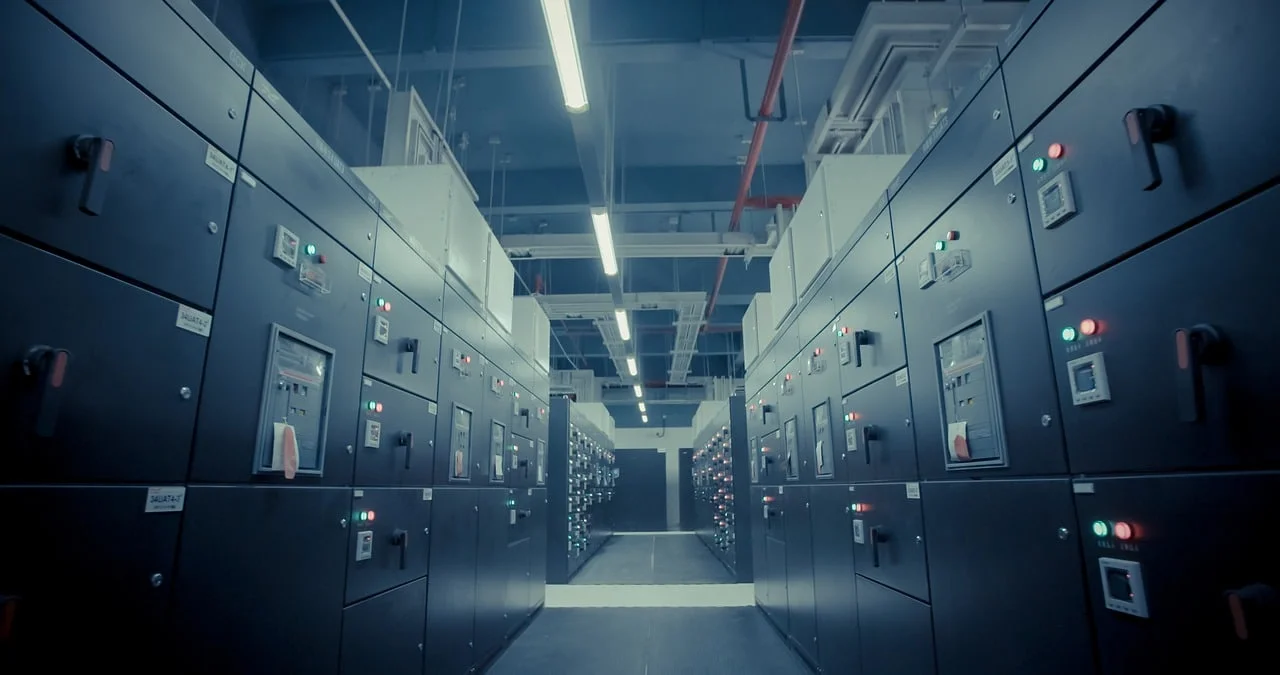
In an ordinary office building or school, mechanical, electrical, and plumbing work typically accounts for 20% of total construction cost. In a hyperscale data center, that figure runs between 60% and 70% — because the entire point of the building is to house compute hardware that generates intense heat and requires enormous electrical infrastructure. 3
Data center server room with rows of electrical cabinets and cooling infrastructure
The electrical and cooling systems — precisely what FIX installs — account for 60–70% of data center construction cost 3
This changes the unit economics of every project FIX wins in the technology sector. With MEP representing 60–70% of a data center's construction budget versus 20% in a conventional building, the same headcount and hours generate far more revenue on a technology project. Gross margin has expanded from 17.9% in FY2022 to 24.1% in FY2025 as the project mix has shifted toward technology. 1

The numbers

チャートを読み込んでいます…
Full year 2025 results, reported February 19, 2026:
MetricFY2022FY2023FY2024FY2025
Revenue$4.14B$5.21B$7.03B$9.10B
Gross margin17.9%19.0%21.0%24.1%
Operating margin6.1%8.0%10.7%14.4%
Net income$246M$323M$522M$1,023M
Free cash flow$253M$545M$738M$1,035M
Backlog (year-end)$5.2B$6.0B$11.9B
Q1 2026, reported April 23, 2026, continued the acceleration. Revenue reached $2.87B (+57% year-over-year on an organic basis of +51%), EPS came in at $10.51 against a consensus of $6.81 — a 54% beat. Backlog rose to $12.45B. Operating cash flow for the quarter was $389M compared to an outflow of $88M in Q1 2025, a swing driven by the sheer scale of upfront customer payments on large data center contracts. 4

The competitive position

Backlog as forward visibility. With $12.45B in contracted work as of March 31, 2026, Comfort Systems has roughly 1.3 years of current-run-rate revenue already signed. That is not a forecast — it is work under contract that has to be delivered. Backlog doubled in the twelve months through December 2025, when it stood at $11.9B versus $6.0B a year earlier. 4
Decentralized scale. The local-subsidiary model gives each operating company the agility of a regional specialty contractor, but with FIX's balance sheet, bonding capacity, and modular factory capability behind it. Competitors cannot easily replicate this: building regional contractor networks through acquisition takes years and requires cultural alignment that is easy to destroy.
Skilled labor in the right places. The company's concentration in secondary markets aligns with where data center construction is actually happening. A contractor that has worked with the same workforce for a decade in Columbus or Phoenix can staff and complete a project faster than one that has to recruit from scratch.

Valuation

At $1,852 per share (June 8, 2026 close), FIX trades at roughly 55x trailing earnings and approximately 44x forward earnings based on analyst estimates of ~$42 per share for 2026. 5
That is not cheap. The bull case rests entirely on whether the backlog is real and converts at sustained margins. The bear case is that the AI infrastructure capex cycle decelerates, large tech customers stretch or cancel contracts, and FIX's fixed cost base — the modular factories, the bonded capacity, the skilled workforce — produces losses rather than gains when volume falls. A comparison: EMCOR, FIX's most comparable large competitor, trades at roughly 30x trailing earnings, which implies the market is paying about a 50% premium for FIX's data center mix and growth rate.

Key risks

  1. Data center concentration. The FY2025 10-K explicitly notes that demand growth has been "especially strong in the technology sector, particularly for data centers." There is no breakdown of what percentage of revenue is now technology. If hyperscale capex decelerates — whether from AI demand disappointment, rising financing costs, or trade policy disruption — FIX's growth story reverses quickly. 6
  2. Project execution risk at scale. Revenue roughly doubled in three years. Managing that rate of growth in a business that requires qualified skilled labor, complex logistics, and multi-year contracts is operationally demanding. The company has executed well so far, but the margin for error shrinks as projects get larger.
  3. Cyclicality. FIX's customer base extends beyond data centers — it also includes healthcare facilities, schools, manufacturing plants, and commercial offices. All of these sectors are cyclical. A broad construction slowdown would hurt the non-tech business even if data center spending holds.
  4. Fixed cost exposure from modular investment. The volumetric modular capability requires sustained capital investment in factory assets. If project volume falls sharply, those assets are hard to redeploy and generate overhead without offsetting revenue.
  5. Valuation at 55x leaves little room for execution misses. At current multiples, a quarter with margin compression or backlog conversion issues would likely produce a disproportionate stock price reaction.

The bottom line

Comfort Systems passes both hard filters by a substantial margin and is one of the clearest direct plays on AI infrastructure spending that also happens to generate actual free cash flow. The investment thesis is straightforward: every data center that gets built needs an MEP contractor, MEP accounts for more than half the data center budget, FIX has the modular capability and regional presence to win that work at expanding margins, and the $12.5B backlog provides concrete near-term visibility.
The risk is equally specific: this is a concentrated bet on the data center capex cycle continuing. If hyperscale spending plateaus or reverses, the story looks very different.
1 4 2

このコンテンツについて、さらに観点や背景を補足しましょう。

  • ログインするとコメントできます。