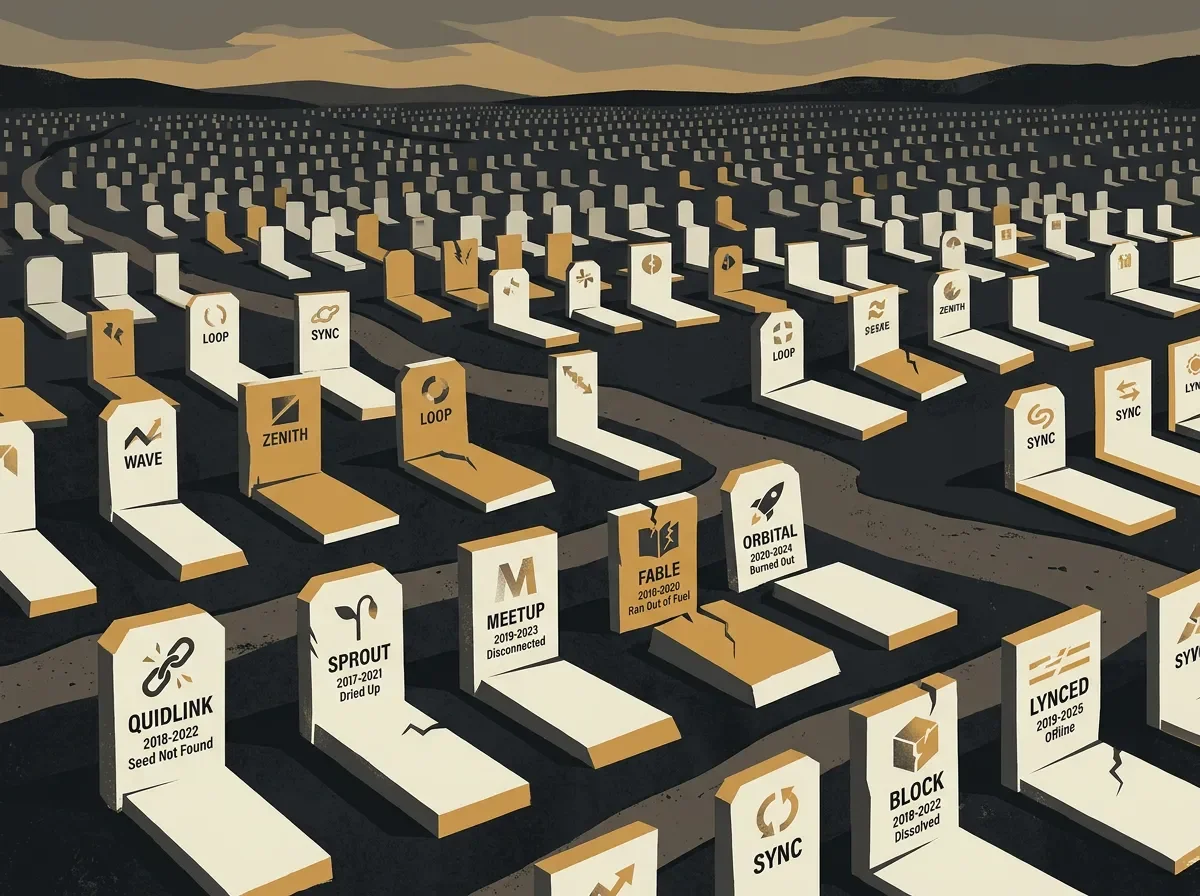
Startup Graveyard Weekly #1: Bench, Chimoney, Edukoya, and Mariner
Four recent closures broken down: Bench ($113M, overnight shutdown), Chimoney (correct product, wrong capital structure), Edukoya (right idea, unready market), and Google Mariner (killed by its own parent). What broke, where the money went, and the one-line lesson from each.

Four startups stopped taking money this past month. One had $113 million behind it. Another had a freshly issued Canadian regulatory licence. A third served 80,000 students — and still ran out of road. The fourth was killed not by the market, but by its own parent company absorbing it.
Each one ends with a line you can actually use.
Bench Accounting — $113M raised, abrupt overnight shutdown
On December 27, 2024, tens of thousands of small business owners woke up to find their bookkeeping platform offline. No warning email the week before. No transition period. Just a landing page notice, effective immediately. 1
Bench, founded in 2012 in Vancouver, had raised $113 million from backers including Shopify and Bain Capital Ventures. It had more than 35,000 U.S. customers and over 600 employees. The model: automated bookkeeping software layered on top of a human accountant team, serving SMBs who couldn't afford a full-time bookkeeper. The product worked well enough to grow to scale.
So what broke? The board fired founder Ian Crosby in 2021, three months after he turned down a $250 million acquisition offer from Brex. The official reason was strategic disagreement — the business was bleeding cash and executives were reportedly frustrated with his leadership style. 2 The incoming professional management team couldn't reverse the trajectory. By late 2024, with no path to profitability and no buyer lined up, the board pulled the plug abruptly — leaving customers three days to download their documents.
The chaos that followed was real. A startup called Kick conveniently had a migration offer ready on Bench's own shutdown notice page. Bench's customers got an unwanted education in vendor risk.
Where the money went: Operations and headcount. 600 people doing a labor-intensive service at software margins.
How it could have gone differently: Either the $250M Brex deal should have closed — that would have been a solid outcome — or the board transition needed a real operational plan. Instead, they got a leadership change without a growth model. Founder-board alignment matters most at the moment it's hardest to have it.
Lesson: Replacing the founder without replacing the unit economics is just rearranging the chairs.
チャートを読み込んでいます…
Chimoney — $1M raised (sub-VC scale), correct product, wrong balance sheet
Chimoney spent four years building what was, by technical and regulatory standards, a real company. It had a FINTRAC licence in Canada, a Payment Service Provider licence under the Bank of Canada's Retail Payment Activities Act (one of the first issued), a functioning API connecting bank transfers, mobile money, gift cards, and stablecoins across 41 currencies, and clients across North America, Africa, and Latin America. In early 2023, transaction value grew 4,500% in a single quarter. 3
Then it ran out of money, because it never had enough to begin with.
Cross-border payment corridors require liquid capital reserves — typically $1–10 million per major jurisdiction — just to pre-fund settlement. Compliance costs for multi-country operations run at 15–20% of gross revenue annually. Chimoney's total raised capital, including grants and accelerator funding, was just under $1 million. It was competing against NALA (which raised $40 million at Series A) on a fraction of the budget. 3
In 2025, founder Uchi Uchibeke tried to reposition Chimoney as AI agent payment infrastructure. The pivot attracted interest but not capital. By February 2026, with flat revenue and failed acquisition talks, the shutdown began. Transactions stopped April 30, 2026. Customer balances will be refunded in full by August 2026.
Where the money went: Regulatory compliance, corridor pre-funding, and KYC vendors — the unavoidable fixed costs of operating a licensed cross-border payments business at global scale.
How it could have gone differently: This is a capitalization problem more than an execution problem. The product was sound. The licences were real. With Series A-level capital, this company likely survives. The mistake may have been choosing a capital-intensive regulated sector without locking in a lead investor who understood infrastructure fintech cost structures before launch.
Lesson: Correct product in the wrong capital structure is still a shutdown.

Edukoya — $3.5M raised, ahead of a market that wasn't ready
When Edukoya raised $3.5 million in 2021 — at the time, the largest pre-seed round ever for an African startup — it was building something genuinely ambitious: live, synchronous K-12 online education in Nigeria, delivered at consumer price points. More than 80,000 students used the platform. Over 15 million questions were answered through it. 4
Founder Honey Ogundeyi shut it down in February 2025, and in doing so made an unusually honest observation: the company was right about the vision, wrong about the timing. Nigeria's mass-market consumer base didn't have reliable broadband, consistent device access, or discretionary income to sustain recurring edtech subscriptions. The infrastructure assumptions baked into the product were built for a 2025 Nigeria that didn't exist yet.
The company explored pivots, mergers, and acquisition conversations. None closed. Remaining capital was returned to investors. The office had been quietly shut for six months before the public announcement. 4
There's something different about this one: the shutdown was handled responsibly. Investors got their money back. No one got burned by a ghost platform. Ogundeyi's honest postmortem is the kind of founder communication that the industry rarely gets.
Where the money went: Product development and operations in a market where customer acquisition was nearly impossible at the targeted economics.
How it could have gone differently: Validation of infrastructure assumptions before building a synchronous product. Asynchronous content delivery — better matched to low-connectivity users — might have extended the runway while waiting for infrastructure to catch up. Or a B2B school partnership model instead of direct-to-consumer, which would have reduced the need to reach individual households.
Lesson: Being right early is indistinguishable from being wrong unless the market moves before your money runs out.
チャートを読み込んでいます…
Google Mariner — $0 raised (internal project), killed by its own parent
Google launched Project Mariner at I/O 2025. The pitch was compelling: a browser-based AI agent that could operate websites the way a human does — clicking buttons, filling forms, booking flights, adding items to carts. It ran inside Chrome, took screenshots to identify UI elements, and handled end-to-end web tasks on the user's behalf.
On May 4, 2026, without a keynote announcement or a goodbye post, Google quietly shut it down. The landing page got a closure notice. Gemini's roadmap mentioned that related technology had been "integrated." 5
The cause of death, in plain terms: the approach was expensive and brittle, and everything Mariner could do, Gemini eventually could do too — for free, with less friction.
The screenshot-based interaction model had fundamental problems. Inference costs were high — running a full end-to-end booking task could cost more in compute than the task itself saved. Anti-bot detection would trip it up. Any site redesign that changed button placement could break it. And users who cared about privacy were uncomfortable with an AI agent continuously capturing their screen. 5 The industry had already moved toward API-based structured agents; Mariner was a vision built on the wrong technical foundation, and by the time that became clear, Gemini had absorbed what was valuable.
This case matters beyond Google because it encodes a failure pattern now affecting the entire "wrapper" AI agent startup category: build a product on top of a foundation model → foundation model improves and natively offers your product feature → you lose distribution, then funding, then the company.
Where the money went: Engineering and compute for a screenshot-based interaction layer that became structurally obsolete.
How it could have gone differently: Either a narrower vertical with proprietary data (where the foundation model can't follow) or a structural pivot toward API-based agents earlier in the development cycle. For external startups copying this architecture, a faster test of whether OpenAI or Google can demo your product in a keynote in under 30 minutes is the most important pre-build question.
Lesson: If a platform can fold your product into a settings toggle, you never had a product — you had a preview of their roadmap.
The pattern this week
Three of these four failures share one root cause: money ran out before market conditions aligned. Bench had the money but lost the founder before it could convert cash into a sustainable model. Chimoney had the licence but couldn't fund the capital structure the business required. Edukoya had the product but not a market that could support it.
Mariner is the odd one out — it didn't fail from lack of resources. It failed because the problem it solved was solvable at the infrastructure level, which is a different kind of terminal diagnosis.
The through-line: a product solving a real problem still needs either the right capitalization, the right timing, or a moat the platform can't absorb. Any one of those is sufficient. None of them is guaranteed.
参考ソース
- 1Bench shuts down, leaving thousands of businesses without access to accounting and tax docs
- 2Khosla Ventures is betting $10M on Ian Crosby, whose first startup, Bench, imploded
- 3Chimoney's million-dollar mismatch
- 4Edukoya shuts down, to return investment after three years in Nigeria's edtech space
- 5What kills AI agent products: Mariner shutdown lessons
このコンテンツについて、さらに観点や背景を補足しましょう。