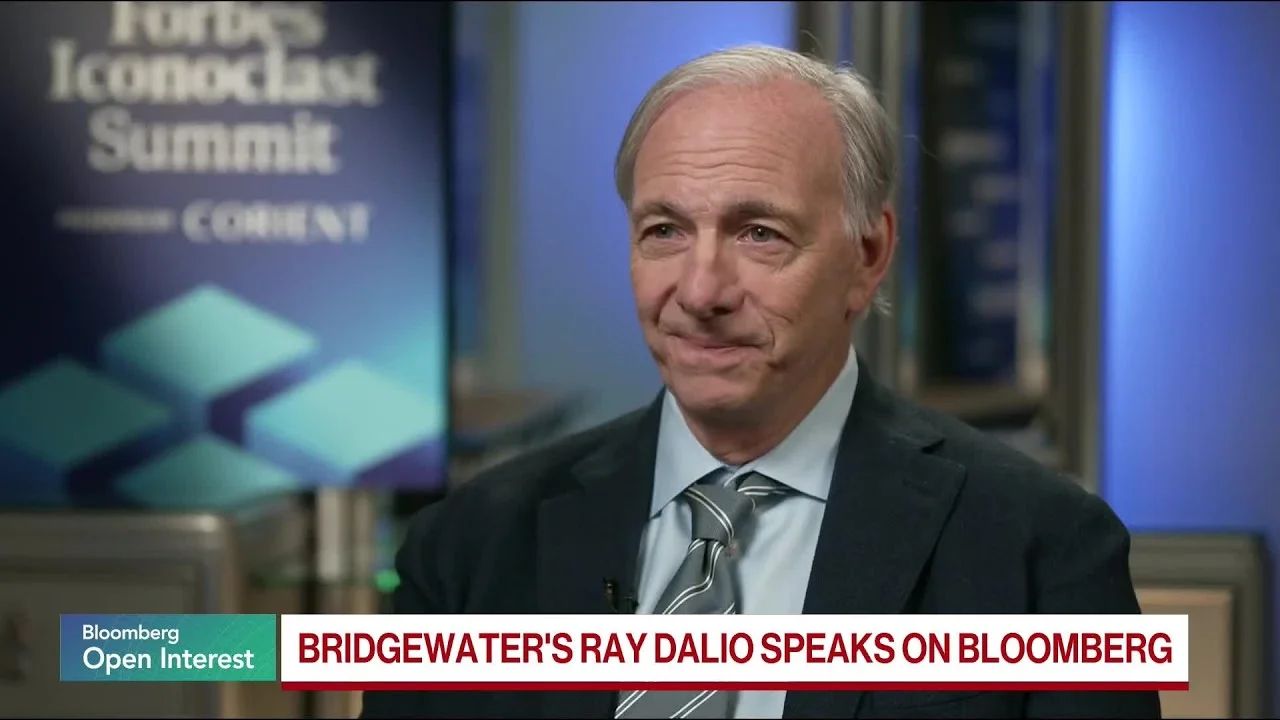
Dalio: U.S. debt is "past the point of no return"

Dalio: U.S. debt is "past the point of no return"

Ray Dalio declared at the Forbes Iconoclast Summit on June 3 that U.S. government debt has crossed an irreversible threshold — $39.2T total, $2T annual deficit — and predicts 1930s-style financial repression as the likely endgame, making long-term bonds unattractive either way.

Master Investors Excerpt
2026/6/7 · 20:27
購読 1 件 · コンテンツ 3 件
Ray Dalio — founder of Bridgewater Associates, the world's largest hedge fund by assets under management at its peak (~$92 billion), and author of Principles — appeared on Bloomberg Television at the Forbes Iconoclast Summit in New York on June 3. 1 His verdict on U.S. government finances was unambiguous: "We're past the point of no return."
コンテンツカードを読み込んでいます…
That line is worth taking literally. Dalio isn't saying a crisis is coming. He's saying the mechanism that would prevent one no longer has enough room to operate.

The $2 trillion math

The basic arithmetic Dalio laid out: the U.S. government spends roughly $7 trillion per year and collects roughly $5 trillion in taxes, leaving an annual shortfall of about $2 trillion. 1 That gap gets filled by selling more Treasury bonds — which adds to a total debt load that has grown from roughly $28.5 trillion to $39.2 trillion over the past five years, an increase of about 37%. 2
統計カードを読み込んでいます…
The structural problem isn't the headline number. It's what the interest payments on that number are doing to the budget's other line items. As debt service rises, it crowds out spending on everything else — and the government has to issue even more debt to maintain baseline expenditures. That's the trap.
Dalio's analogy for it: "We're past the point of no return, meaning, when debt service payments squeeze out spending, like plaque in the circulatory squeezes out the flow of money, the flow of blood." 1 Plaque, by definition, doesn't reverse on its own. It builds slowly and then constrains function.

How the feedback loop runs

Dalio identified what makes this dynamic self-reinforcing. Budget deficits require more bond issuance (supply up). But buyers of those bonds demand higher real returns to justify holding them — particularly when inflation risk is present (demand weakens unless yield rises). Higher yields mean higher borrowing costs for the government. Higher borrowing costs mean even larger deficits. Larger deficits mean even more issuance.
He put it plainly: "The supply of, one budget deficit means that debt has to be sold, and you have a supply demand issue. And we could see it happening in the bond market, and we could see that bonds have been a bad investment." 1
His warning about the market signals that are already visible: long-term yields rising relative to short-term yields (the front edge of what bond markets do before a forced adjustment), a weakening dollar, and a persistent move toward gold as a reserve alternative. Gold returned roughly 35% over the past year as of the interview. 1

Where it ends: financial repression

When a government can't pay its way through growth or cuts, it has a third option: manipulate the cost of debt downward. Dalio labeled what he expects as financial repression — a 1930s-vintage playbook where the central bank buys bonds to suppress yields, tolerates higher inflation to erode the real value of debt, and may eventually impose capital controls to prevent money from leaving. "That's I think it's exactly headed to that kind of thing, which we also saw a number of times through quantitative easing. It's called financial repression, and the idea is that you drive the bond yields down with buying of assets and so on." 1
He added: "The bond market either is fundamentally good by providing a high enough real return to compensate people, or it's going to be manipulated in a sense this way that will make it unattractive. In either case, it's relatively unattractive." 1
That's the portfolio read embedded in the argument. If bonds either pay an honest yield (which strains the government's finances) or get suppressed (which means negative real returns for holders), they're a poor risk-adjusted instrument either way. The money flows elsewhere — historically toward real assets, commodities, and inflation-resistant stores of value.
Dalio also flagged the 2026 midterms through 2028 presidential election window as a period of compounded fragility, when debt pressure and political dysfunction are likely to overlap. 2 On whether political cooperation could course-correct: "I'm not optimistic on us working together to solve some of these issues." 1
Kevin Warsh — named as the incoming Federal Reserve chair — will inherit this environment. Dalio's read is that Warsh will face a bond market stress test that the Fed cannot navigate cleanly: tighten to defend the dollar and you hurt growth; ease to protect growth and you accelerate the inflation that erodes the debt.

What to watch

Three variables that move the timeline on Dalio's thesis:
  • Long-end yields: The 10-year and 30-year Treasury yield spread relative to 2-year is the early-warning gauge Dalio points to. Rising long-end yields with flat or falling short-end rates mean the bond market is already pricing in fiscal risk.
  • Fed independence signals: Any shift in Fed posture toward overt yield curve control — bond buying specifically to cap long rates — would confirm the financial repression trajectory Dalio describes.
  • Dollar and gold: A sustained dollar decline paired with gold making new highs (already up ~35% year-over-year) is, by Dalio's framework, the capital allocation market voting on sovereign credit quality.
Dalio's note of internal consistency: "One man's debts are another man's assets." 1 The debt doesn't vanish — it restructures who bears the loss. In financial repression, that's the bondholder. In a hard default, it's a broader creditor base. The question Dalio is asking investors to answer is which path arrives first, and whether their portfolios are positioned for it.
Cover image: Bloomberg Television / YouTube.

このコンテンツについて、さらに観点や背景を補足しましょう。

  • ログインするとコメントできます。