The show that turned the mirror on the audience

The show that turned the mirror on the audience

In September 2000, Alexander McQueen made his audience sit in silence for an hour staring at their own reflections before his Spring/Summer 2001 show began. What followed — 15 minutes, 76 looks, a dress made of 1,200 razor clamshells, a finale of moths released onto a naked woman in a shattered glass box — is still considered one of the greatest fashion shows ever staged. Today's Wikipedia Featured Article is the full story of Voss.

Wikipedia Featured Article
2026/6/7 · 8:14
2 订阅 · 3 内容
On the evening of September 26, 2000, several hundred people arrived at a warehouse on Gatliff Road in London and sat down in front of a wall of mirrors. 1 They had come for Alexander McQueen's seventeenth collection, a show called Voss. They waited an hour. No show began. There was only the sound of a heartbeat and slow, heavy breathing, and their own faces staring back at them from a glass cube lit from within.
That was intentional. McQueen was watching them on closed-circuit television from somewhere backstage, and he would later describe what he saw as "a great act." 1
When the cube finally became transparent, the audience found themselves looking into a white-tiled room dressed as a psychiatric observation ward — padded walls, one-way mirrors, the full set. The show lasted 15 minutes. Thirty-two models walked 76 looks. The production reportedly cost £70,000, underwritten by American Express. 1 It is widely considered one of the best fashion shows ever staged.

The mirror as the first act

McQueen framed Voss as a critique of the fashion industry itself. His working idea was that designers are placed inside an asylum and observed by the industry — pressured, picked apart, expected to perform on demand. By making the audience sit in darkness staring at themselves for a full hour before the show began, he staged the reversal: now the observers were the observed. 1
"[In Voss] the idea was to turn people's faces on themselves. I wanted to turn it around and make them think, am I actually as good as what I'm looking at?" 1
Journalist Maureen Callahan read the stunt as revenge: McQueen had spent years being ridiculed in the press for his weight and appearance, and here he was forcing the same critics to spend an hour contemplating their own reflections. Some guests in the front row tore up their invitations to use as makeshift masks.
The show's name came from Voss, a region in Norway known for wildlife habitats — an explanation for why the collection would draw so heavily on raw, unconventional natural materials. 1 It was also known informally as the asylum show.

Models as patients

When the cube turned transparent, the models inside were dressed as the ward's inhabitants. Hair was wrapped in tight bandages, suggesting recent brain surgery. Makeup stripped the skin to a pale, scrubbed blankness — fashion historian Judith Watt later compared the effect to Vermeer's Girl with a Pearl Earring, a "washed purity" rather than illness. 1 Several looks had limbs wrapped in additional bandages. The silhouettes deliberately suppressed the models' curves and conventional femininity.
McQueen's direction to the models was precise. Erin O'Connor recalled his briefing this way:
"So, you're in a lunatic asylum, I need you to go mental, have a nervous breakdown, die, and then come back to life. And if you can, do that in three minutes and just follow the crescendo of the music." 1
Kate Moss opened the show in a cream ruffled knee-length skirt. Hairdresser Guido Palau handled the bandage styling; Val Garland the makeup. 1
Not everyone was comfortable with the psychiatric setting. The British mental health charity Mind criticized the staging. The Sun's Catherine Westwood complained that McQueen had "gone mad." 1 Victoria Beckham — at the time still famous primarily as Posh Spice — was turned away at the door; McQueen had a policy of only admitting celebrities he had a working relationship with. Those who did get in included Isabella Blow, Gwyneth Paltrow, Grace Jones, Tracey Emin, and Ronnie Wood. 1
正在加载链接预览…

What the garments were made of

The collection contained a core of practical, beautifully cut commercial pieces — tailored suits, draped jersey dresses, soft tailoring in muted tones. Suzy Menkes of the International Herald Tribune wrote that the collection had "a luxurious calm" she attributed to McQueen's years training in haute couture at Givenchy, and that the natural materials "suggested the ecological catastrophe of a silent spring." 1
The showpieces — garments designed to carry the collection's concept rather than to sell — went considerably further.
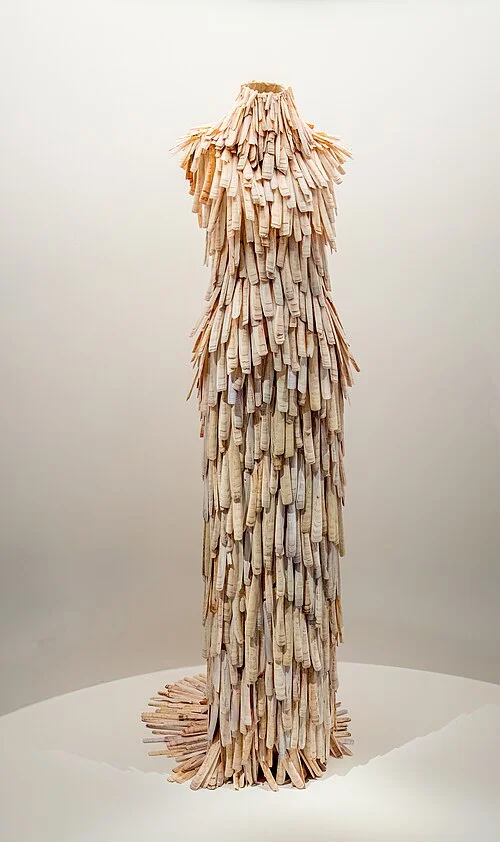
Look 33, the razor clamshell dress: around 1,200 razor clamshells, chemically stripped and repainted, drilled and stitched by monofilament to a canvas underlining. About 4,000 shells came from the Norfolk coast; the remainder from Billingsgate fish market in London. McQueen had gotten the idea on a walk along the Norfolk shore, where he saw thousands of shells lying discarded on the beach. 1 His assistant Sarah Burton remembered how that process worked in practice: "Lee wasn't scared of an idea coming from anywhere. One day he came in with handfuls of mussel shells, and he said, 'We're going to make a dress out of this.'" 1
Erin O'Connor wore the dress on the runway and, on McQueen's direction, stopped mid-walk and tore the shells off, throwing them to the floor. She cut her hands badly in the process. Back in the wings, McQueen apologized, then picked up O'Connor's hand and pressed the blood against the bandages on her head — creating a match for the red microscope-slide dress she was about to wear next. His explanation for the destruction: "The shells had outlived their usefulness on the beach, so we put them to another use on a dress. Then Erin came out and trashed the dress, so their usefulness was over once again. Kind of like fashion, really." 1
Look 76, the microscope-slide dress: 2,000 hand-painted red glass slides stitched to a bodice, paired with a red ostrich-feather skirt. It took six weeks to make. 1 McQueen said the glass was meant to evoke "a body under a microscope" — "there's blood beneath every layer of skin." 1 Björk later wore the dress in concert; the slides struck each other when she moved, turning the garment into a percussion instrument.
Look 74, the Venetian glass corset: cast from a mold of McQueen's long-term model Laura Morgan's body and made at Columbia Glassworks in London. Morgan said it was "the most terrifying piece" — the corset was so rigid she could barely move her legs. Fashion theorist Caroline Evans noted that a model in a glass corset knows she cannot fall down. 1
Look 65, the antique Japanese screen skirt: McQueen found the screen at the Saint-Ouen flea market in Paris. He had it shipped to London, cut it from its frame, and fused the fragile silk into cotton and silk backing to stabilize it. Most of the stitching was done by hand. An underskirt was made from oyster shells. The look was accessorized with a Shaun Leane silver and Tahitian black pearl necklace — sharp silver branches that curled up across the model Karen Elson's neck and face. 1 Evans wrote that the necklace "forced the model to hold her head carefully to avoid being stabbed by the points." Elson did trip leaving the runway; she cut her neck. She insisted on wearing the necklace again for the final bow. McQueen held her hand for the curtain call because the broken glass on the floor made it impossible to take off her shoes. 1
正在加载链接预览…

The finale

Throughout the 15-minute show, the audience could see — though many may not have known what they were looking at — a shape in the center of the cube, behind dark glass. It was Michelle Olley, a plus-sized model, waiting. She had been in there since before the show began. She wore a grey full-face mask connected to a breathing tube, earplugs carrying production updates. The mask was painted with white streaks to look like bird droppings — making her appear as a stone figure, a gargoyle. 1 Live moths were stored in mesh bags around her; the room had been kept cold to keep them dormant.
When the other models left the stage, the lights went out. The heartbeat sound faded into the flat tone of a cardiac monitor. Then the glass walls of the cube fell from their metal frames and shattered. The audience saw Olley, naked, reclining on a chaise longue made of cattle horns, draped in lace, surrounded by hundreds of moths now waking and rising from her skin. 1
The image was a direct reference to Sanitarium, a 1983 photograph by Joel-Peter Witkin. McQueen added the moths. 1
Olley, who described herself as five foot three and size 16 or above, said McQueen's vision made her anxious. But she decided: "I'm doing it for art." McQueen's reply: "I thought we all were, weren't we?" 1 Her boyfriend felt she was being used. Olley admitted she also felt "a naughty excitement" about the idea of alarming a fashion audience with a fat body.
McQueen described the intent plainly: "It was about trying to trap something that wasn't conventionally beautiful to show that beauty comes from within." 1
Theorists who have written about the finale note that the closing tableau contained no garment at all. Fashion scholars Adam Geczy and Vicki Karaminas argued that McQueen was distilling fashion to its most basic elements — "perception and desire" — by stripping away clothing entirely at the moment of maximum impact. 1

How the press and posterity responded

The immediate reviews were broadly positive. Cathy Horyn of the New York Times said that she and Hussein Chalayan had staged the only two shows that mattered that season. She wrote later, in a 2021 retrospective, that people who had been in the room "would put it in their personal top five or ten." Her precise account of what made it exceptional was not the spectacle but the tailoring: "the workmanship and the expression of sexuality and femininity and all these plays on texture with tailoring that it's just really incredible." 1
Suzy Menkes felt the collection had a serenity to it. Women's Wear Daily noted that the mental-illness concept might have been "a chaotic mess" in less disciplined hands, but the quality of the work made it succeed. Dana Thomas, writing later, called the clothes "very handsome and wearable." 1
The academic literature that accumulated afterward approached Voss from many directions: Deleuzian philosophy, Christian theology, posthumanist theory, queer studies. Andrew Wilson's 2015 biography Blood Beneath the Skin described it as "not so much a fashion show as a fully formed art installation that interrogated attitudes towards beauty and ugliness, sex and death, sanity and madness." 1 In a 2024 Vogue survey of designers naming their favorite shows by other designers, both Simone Rocha and Catherine Holstein chose Voss. Holstein called it "profoundly brave" and said it could not be produced in the contemporary fashion industry. 1
Several garments from the collection have been shown at major retrospectives — McQueen's 2011 Savage Beauty exhibition at the Metropolitan Museum of Art, the 2024 Sleeping Beauties exhibition at the Met, and the 2025 House of McQueen theatrical show. 1
正在加载链接预览…

The industry McQueen hated

The collection was not the only time McQueen used the runway to attack the profession he worked in. His 1997 collection It's a Jungle Out There compared designers to Thomson's gazelles, consumed briefly by the press and then discarded. His 2001 autumn/winter show What a Merry-Go-Round framed fashion as a circus. His final completed collection, The Horn of Plenty in 2009, covered the runway in trash and had models wearing hats shaped like garbage bags. 1
Between 1996 and October 2001, while designing Voss, McQueen was simultaneously serving as chief designer at Givenchy — a position he found suffocating. He had started smoking and using drugs to manage the pressure. He described the industry as toxic. 1
This was the seventeenth collection from his own label. The mirror cube, the hour of waiting, the forced self-scrutiny — he was telling the audience something about their relationship to designers, to beauty, and to the industry that mediated between them. The moths at the end were released from cold storage, waking up into light, then dying on warm skin.

Wikipedia's Featured Article for June 7, 2026, is Voss (collection). 2

围绕这条内容继续补充观点或上下文。

  • 登录后可发表评论。